Month: March 2018
First Steps in PICO-8: Hitting things


A game without any collisions would be a very boring game indeed, but programming the functionality required for collisions is something that leaves a lot of people baffled. This post take you through a very simple collision function…
Read More »First Steps in PICO-8: Moving a character on screen
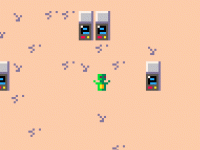
As soon as you have started PICO-8 you will want to get an object to move around the screen. In this post, I look at getting a character to move around the screen and get that character to…
Read More »Collisions between objects using line intersection
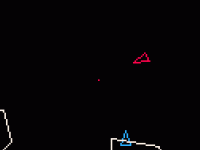
Collisions are always one of the more difficult aspects of computer game programming. One very useful method of determining whether one object has hit another is to check whether two lines cross each other. As an example, consider…
Read More »Friction and Inertia in Computer Games: Making things drift

One of the best ways to make a computer game feel ‘real’ is to add inertia to your characters. In order to do this you have to move away from directly positioning them and instead control their velocity…
Read More »First Steps in PICO-8: Set up a new PICO-8 project

PICO-8 enables you to become a computer games programmer without the distractions of a cumbersome IDE or a complex set of libraries and hardware compatibility issues. This series of posts will take you through various challenges that you…
Read More »Responding to Buttons using Bitwise Addition in PICO-8
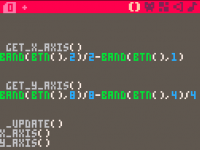
It is possible to respond to each button press in PICO-8 by using conditional statements like this: if btn(0) then vx=-1 end if btn(1) then vx=1 end if btn(2) then vy=-1 end if btn(3) then vy=1 end But…
Read More »